🇺🇾 Uruguay · Headquarters in Montevideo · Sofis since 2005

Technology with a public purpose in Uruguay

From our headquarters in Montevideo, we design and develop digital solutions for public institutions, state-owned enterprises, and international organizations. This is where Sofis was born, and where we built a significant portion of the systems that currently underpin the operations of the Uruguayan state.

More than 40 projects with the Uruguayan State Systems in operation since 2007 AGESIC · Electoral Court · INE · ANEP Headquarters and regional engineering center
Presence

Our presence in Uruguay

The company's headquarters and the engineering center that supports projects across the entire region.

Sofis was founded in Montevideo in 2005, where it maintains its headquarters and main engineering center. Two decades of working with the Uruguayan government have yielded an understanding of institutional operations that now underpins every one of the company's projects in the region.

Structure Company headquarters Sofis was founded in Montevideo in 2005. The company's headquarters and main engineering center are located there.
Path More than 40 projects with the Uruguayan State Systems in continuous operation since 2007 within agencies across all branches of government.
Supplier registration Authorized supplier to the Uruguayan State Registered in the Unified State Suppliers Registry, a system that Sofis itself built.
Address in Montevideo Dr. Luis Piera 1921, Office 201 Montevideo, Uruguay
Contact info@sofis.lat (+598) 2418 8902 · Institutional, commercial, and contracting inquiries.

Regional Engineering Center

Engineering, quality, safety, and data teams based in Montevideo also support projects in Ecuador, El Salvador, and Panama. This capability enables the scaling of a project with a national scope without losing continuity or accumulated knowledge.

Software engineering Quality and testing Information security Data and interoperability Artificial intelligence
Experience

Featured projects

A selection of the more than forty projects delivered to the Uruguayan State, chosen based on their national scope and institutional diversity. Each case starts with the institutional problem, not the technology.

National Statistics Institute · Since 2022 · Operational

2023 Population and Housing Census

National census web form

Institutional problem

A national census requires reaching every household in the country within a limited timeframe. Relying solely on in-person data collection constrains the operation's coverage and cost, while the digital alternative had to address the need to uniquely identify each household, ensure data accuracy, and handle spikes in demand that were difficult to anticipate.

Developed solution

A system that enables citizens to complete the census form quickly, simply, and securely, based on a microservices architecture featuring a straightforward web form designed in collaboration with multidisciplinary teams linked to the National Statistics Institute.

Beneficiaries

The country's households, the National Statistics Institute, and all the agencies that use census data for planning.

Result

More than 50% of households completed the form online, the highest proportion in Latin America. According to the UNFPA, these data are critical for development planning, monitoring the SDGs, the distribution of social programs and infrastructure, and election planning.

Censo Web
Microservices architecture Scalability and demand spikes National statistics Citizen digital services
View full case →
AGESIC · Since 2015 · Operational

Advanced Electronic Signature Platform (PFEA)

Cross-cutting electronic signature service for the State and the public

Institutional problem

The digitization of a procedure hits a roadblock at the signature stage. Without a shared advanced electronic signature service, each agency had to independently address the legal validity of its documents, resulting in solutions that were mutually incompatible and difficult for citizens to use.

Developed solution

A platform that enables the digital signing of PDF documents from Windows, Linux, or Mac using an electronic ID card, a personal digital certificate, or a digital identity from various providers. It supports authenticated uploads (via ID Uruguay) or anonymous uploads for signing or validating signatures, and offers integration capabilities allowing other applications to submit documents and retrieve them once signed.

Beneficiaries

Citizens signing documents, state agencies requiring legally valid documents, and third-party applications integrating with the platform.

Result

The Uruguayan State has a cross-cutting signature service available for use by any agency, replacing the multitude of isolated solutions associated with digitized procedures.

pfea
Advanced electronic signature Digital identity Cross-cutting State services Multi-platform integration
View full case →
Electoral Court · Since 2021 · Operational

Electoral Management System

Automation of national election logistics

Institutional problem

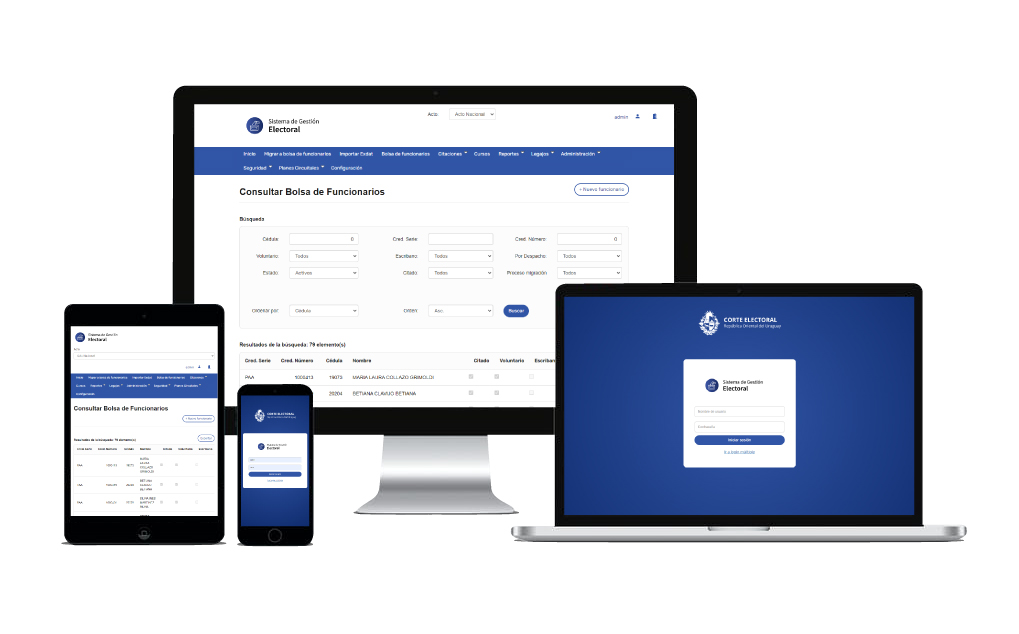
Organizing a national election entails deciding where each citizen votes, which polling stations are opened, and who staffs each polling table, all while complying with current regulations. Handling this manually is a massive undertaking—slow to verify and difficult to audit.

Developed solution

A system that automates electoral logistics: creation of the polling district plan using allocation optimization algorithms, management and assignment of polling stations, formation of polling station committees—prioritizing the assignment of individuals to their designated voting districts—and management of member training.

Beneficiaries

The voting public, the individuals summoned to serve on polling station committees, and the Electoral Court teams responsible for the operation.

The logistics of a national election event are planned according to explicit and verifiable rules and can be recalculated when the underlying data changes.

Sistema de Gestión Electoral
Electoral processes Optimization algorithms Mission-critical systems Regulatory compliance
View full case →
DGREC DNIC Ministry of Public Health
· Since 2020 · Operational

Digital Civil Registry

Interconnection of civil registration, identity, and vital statistics

Institutional problem

Civil registration, personal identification, and the generation of vital statistics were handled by separate institutions, relying on paper records and manual processes. Each vital event had to be registered multiple times, and the country's statistics depended on that chain.

Developed solution

Civil Registry Management System (SGREC) that automates the registration of acts and events related to civil status and the issuance of certified copies of records, featuring interconnection among the Ministry of Public Health, the National Civil Identification Directorate, and the General Directorate of the Civil Registry via the E-Government Platform. It includes the electronic issuance of new records as well as the indexing and digitization of existing records.

Beneficiaries

The citizens who process vital records, the three interconnected institutions, and those who produce the country's vital statistics.

Result

A vital event is recorded once and circulates among the agencies that require it. The scope also included infrastructure management: communications, security, and backup.

Civil registry and identity Interoperability Digitization of the collection Managed services
View full case →
ANEP / CEP · Since 2015 · Operational

GURÍ Project

Unified Management of Primary Education Information Records

Institutional problem

Student and teacher records were scattered across schools, varying in quality. Obtaining national statistics or monitoring compulsory attendance required manual consolidation, and administrative offices and school leadership spent long hours on administrative tasks rather than on educational matters.

Developed solution

Centralized information system for the Unified Management of ANEP/CEP Information Records, which consolidates student and teacher databases, enables the generation of national-level statistical data, and allows for the monitoring and enforcement of mandatory student attendance.

Beneficiaries

Primary education students and teachers, school administrative and leadership staff, and the ANEP teams that compile educational statistics.

Result

Reduction of administrative time, enabling administrative staff and principals to focus on pedagogical activities. Data systematization also improves the quality of responses to information requests.

Proyecto Gurí
Education Centralized records Educational statistics School management
View full case →
Uruguayan State · Since 2012 · Operational

RUPE — Unified State Supplier Registry

Centralized supplier database for all public procurement

Institutional problem

Each agency maintained its own supplier registry and independently verified documentation and certificates. Suppliers had to repeat the same process for each buyer, and the State lacked an aggregated view of the parties with whom it contracted.

Developed solution

A platform that consolidates data from all suppliers into a centralized database and automates registration, document validation, and certificate monitoring—such as maintaining good standing with the Tax Authority (DGI) and ensuring compliance with insurance and social security laws. It integrates both legal entities and individuals—whether Uruguayan or foreign—and enables interoperability with other systems via the E-Government Platform.

Beneficiaries

State suppliers, purchasing agencies, and decision-makers regarding quantitative public procurement data.

Result

The supplier registers once and contracts with the entire State. Purchasing agencies work from a single verified database that has been in operation since 2012.

Registro Único de Proveedores del Estado
Public procurement Centralized records Interoperability Document validation
View full case →
Electoral Court · Since 2021 · Operational

Online services for citizens

Automation of Electoral Court procedures

Institutional problem

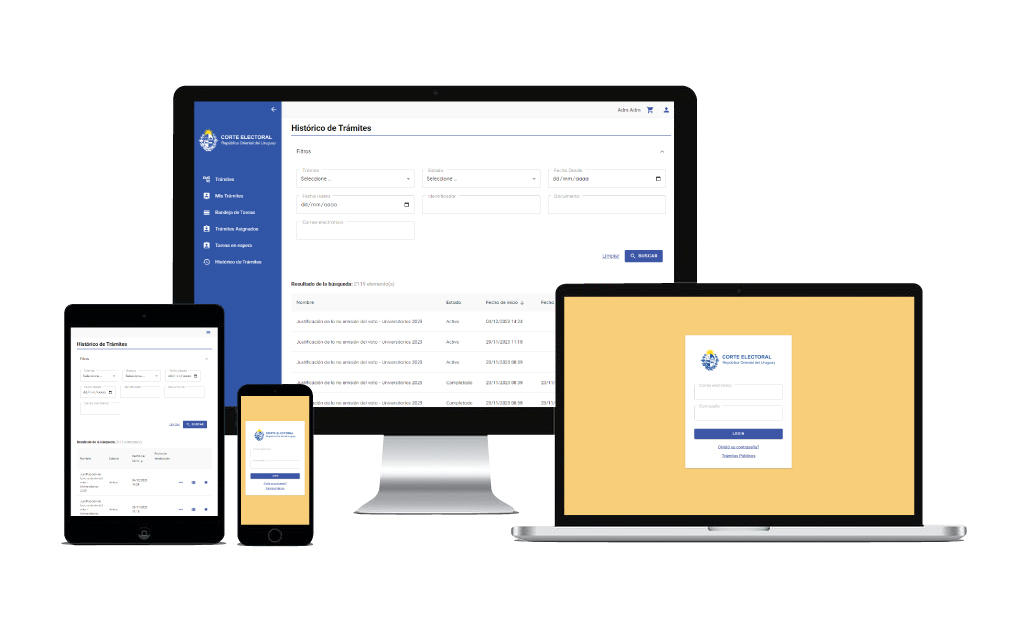
Voting certificates, justifications for not voting, fine payments, and volunteer registration were handled in person, even though these involved documents that other agencies routinely require from citizens.

Developed solution

A management tool covering the end-to-end procedure: initiation by the citizen via the services portal, internal resolution by the agency through process automation, issuance of documentation, and delivery to the citizen.

Beneficiaries

The citizens who need that documentation, the agencies that require it, and the Electoral Court teams that previously processed it at the service counter.

Result

High-frequency procedures no longer require physical presence, as the internal process is handled automatically and documentation is submitted digitally.

Trámites en línea para la ciudadanía
Online services Process automation Citizen services Documentary broadcast
View full case →

These are seven of the more than forty projects delivered in Uruguay. View the full catalog →

Capabilities

Priority capabilities for Uruguay

01

Digital identity and electronic signature

Cross-cutting services that enable the rest of the digital government—such as legally valid advanced electronic signatures, digital identity integration, and the electronic issuance of official documents—available for use by any agency.

Evidence in Uruguay Advanced Electronic Signature Platform (AGESIC) · Digital Civil Registry
02

Electoral systems

Critical systems for the electoral cycle: electoral district planning using optimization algorithms, formation of polling station committees, citizen services, and vote-counting analytics. Software that must operate without any margin for error on a fixed date.

Evidence in Uruguay Electoral Management System · Online Services · Election Process and Vote Count Analytics
03

Public records and interoperability

National registries serving as the single source for the rest of the State, interconnected via the E-Government Platform. Data is entered once and flows to the agencies that require it.

Evidence in Uruguay Unified State Supplier Registry · Digital Civil Registry · Unified Registry of Uruguayans Abroad
04

Mass-reach digital services

Services used simultaneously by the entire population: architectures designed to handle hard-to-anticipate demand spikes, focusing on ease of use, data accuracy, and availability during critical windows.

Evidence in Uruguay 2023 Population and Housing Census · Online services for citizens
05

Educational management

Systems that centralize education system records—students, teachers, attendance—to free up administrative time in schools and generate national sector statistics based on a single data source.

Evidence in Uruguay GURÍ Project (ANEP/CEP) · Digital Portfolio
06

Responsible AI applied to the State

Assistants, as well as document classification and analytics applied to public processes, featuring human oversight, decision traceability, and data control. Our practice is governed by a corporate-level AI management policy and a certified management framework—a common requirement for processes involving international cooperation and multilateral banking.

Framework and support AI Management Policy · Human-in-the-loop · ISO 9001 · ISO 14001 · ISO 37001 · CMMI-DEV Level 3
Sectors

Priority sectors

Sectors in which we have delivered and operate systems alongside Uruguayan institutions.

Electoral processes

Electoral logistics, voter rolls, citizenship procedures, and vote-counting analytics.

Electoral Court

Identity and civil registry

Registration of vital events, issuance of certificates, and institutional interconnection.

Digital Civil Registry

Digital governmentl

Advanced electronic signature and digital identity as cross-cutting services.

PFEA · AGESIC

Education

Unified records of students and teachers, attendance, and educational statistics.

GURÍ Project · ANEP

National statistics

Census operations and baseline information systems for planning.

2023 Census · INE

Public procurement

Supplier registration, document validation, and procurement systems.

RUPE

Citizen services

Online procedures, electronic scheduling, and digital service channels.

Cross-cutting across the projects

Data and interoperability

Integration via the E-Government Platform and data quality.

Cross-cutting across the projects
Content

Uruguay at Sofis

Projects, news, events, publications, and vacancies associated with Uruguay, automatically updated from the content management system.

Contact

Speak with our team in Uruguay.

Direct point of contact for institutional inquiries, public procurement processes, and international cooperation projects.

Headquarters · Montevideo

Dr. Luis Piera 1921, Office 201
Montevideo, Uruguay
(+598) 2418 8902
Authorized supplier to the Uruguayan State
Engineering center supporting projects in Ecuador, El Salvador, and Panama.
Write to info@sofis.lat